The Sacred Landscapes of Makalu–Barun National Park
A deep look into the wilderness, culture, ecology and spiritual traditions that make Makalu–Barun one of the last untouched sanctuaries in the Himalayas.
A Park Unlike Any Other in Nepal
Makalu–Barun National Park is one of the most extraordinary protected landscapes in the entire Himalayan arc — a place where dense subtropical forests rise into icy cliffs, where rare wildlife still roams, and where mountain spirits and ancient rituals continue to shape community life. Spread across 1,500 km² in eastern Nepal (plus 830 km² of buffer zone), the park sits at the heart of the Sacred Himalayan Landscape, a conservation corridor connecting Nepal, Tibet and India.
What makes Makalu–Barun truly unique is its dramatic elevation range — from 435 meters in the Arun River valley to 8,485 meters at the summit of Mt. Makalu. This creates one of the world’s steepest ecological gradients, allowing a single trekker to walk through environments that resemble tropical Southeast Asia, temperate Europe and Arctic tundra all in one journey.
But beyond its biodiversity and geology, there is something deeper: a sense that this landscape is alive. In the stories of the Rai, in the chants of Sherpa monks, in the silent reflections of herders in the Barun Valley — Makalu–Barun is a sacred space, revered long before trekking existed.
The Spiritual Geography of Makalu–Barun
To understand Makalu–Barun, one must understand its spiritual geography — a network of beliefs, sacred sites and stories passed down through generations. In this region, mountains are not mere peaks. Valleys are not just terrain. Waterfalls, forests and glaciers carry spiritual meaning and are tied to ancestral memory.
The Rai Cosmology
In the lower valleys, the Rai people follow Mundhum, an ancient oral scripture that blends creation stories, ancestral worship, nature rituals and moral teachings. According to Mundhum beliefs:
- Forests are home to guardian spirits.
- Rivers are energetic pathways between the human and spiritual worlds.
- Mountains represent strength, protection and ancestral presence.
Ritual specialists known as dhami or jhakri perform ceremonies to maintain harmony between humans and the natural world. During the agricultural festivals of Ubhauli and Udhauli, Rai communities honor the vertical movement of life — the rising and descending rhythms of seasons, livestock and crops.
Sherpa & Bhote Sacred Spaces
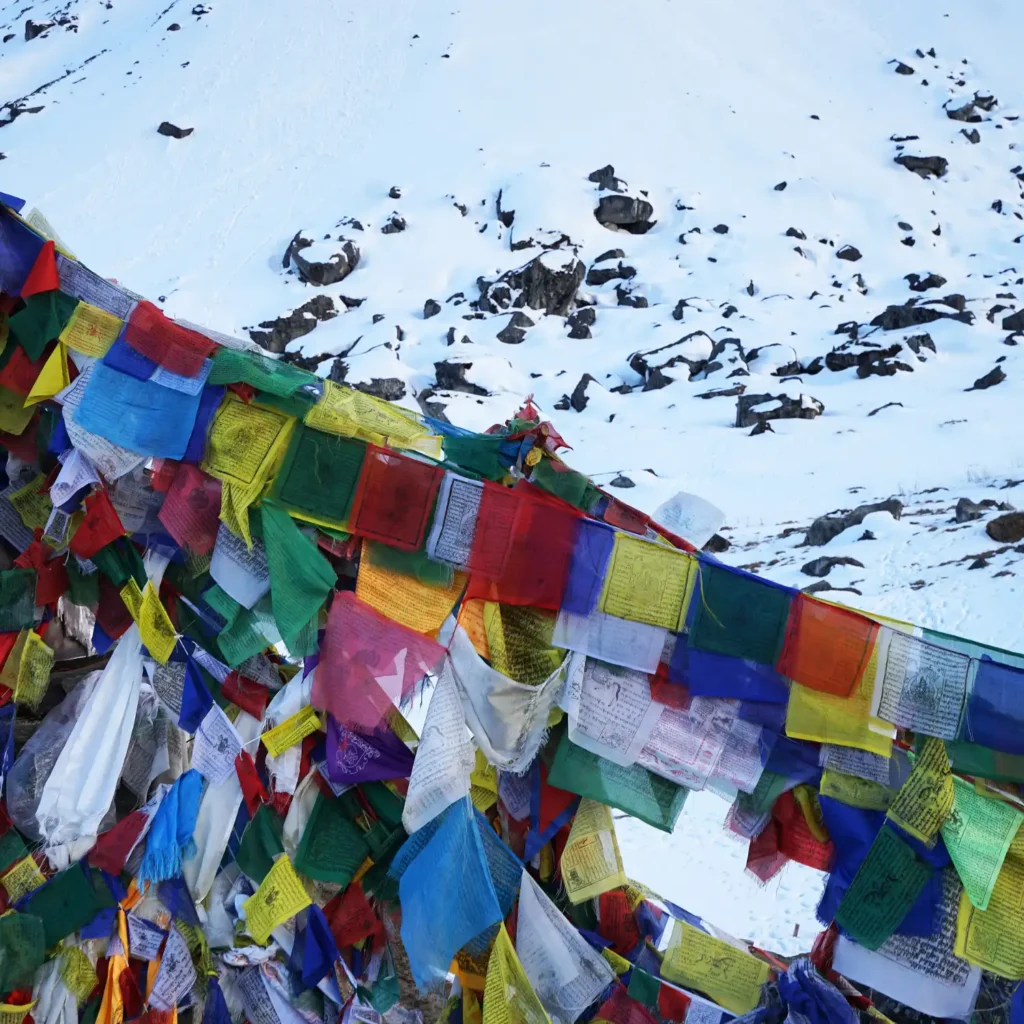
Higher up, the landscape becomes deeply influenced by Tibetan Buddhism. Chortens, mani walls, prayer wheels and hillside shrines mark the paths used for centuries by herders, traders and monks. Mountains like Makalu, Chamlang and Baruntse are considered powerful deities, and the Barun Valley is often described by monks as a natural mandala — a vast spiritual diagram formed by ridges, rivers and glaciers.
The Barun Valley: A Sanctuary of Ancient Forests and Ice
The Barun Valley is the heart of Makalu–Barun National Park — a dramatic U-shaped glacial corridor carved over millennia by the Barun Glacier. Few places in the Himalayas offer such raw, untouched beauty. Here, trekkers walk beneath cliffs that rise thousands of meters almost vertically, pass waterfalls that roar like monsoon thunder, and witness glaciers that appear to be frozen in time.
The valley supports an astonishing range of habitats:
- Lower Barun forests with birch, rhododendron, maple, magnolia and ancient juniper.
- Mid-valley alpine meadows rich with primula, dwarf rhododendron, gentian and the rare blue poppy (Meconopsis).
- Upper glacial zones where nothing grows except mosses, lichens and ice-hardened shrubs.
Wildlife here includes snow leopards, musk deer, Himalayan black bears, red pandas and more than 400 bird species. Though sightings are rare, signs are everywhere — claw marks on trees, tracks on snow, distant calls echoing at dusk.
Trekkers often describe the Barun section as a moment of transformation. After days of steep climbs through mist and forest, emerging into this wide, glacial amphitheater feels like entering another world — one shaped by ancient forces and untouched by modern development.
Biodiversity Hotspot: One of the World’s Most Valuable Ecosystems
Makalu–Barun National Park is internationally recognized as one of the world’s richest biodiversity zones. Its combination of elevation, monsoon influence and geographic isolation creates extraordinary biological variety.
Flora
- Subtropical forests of sal, pine and bamboo.
- Temperate forests rich in oak, maple, birch and magnolia.
- Subalpine slopes with fir, juniper and rhododendron species.
- Alpine meadows filled with medicinal herbs, primulas and the blue poppy.
Fauna
- Snow leopard (extremely elusive).
- Red panda in mid-altitude forests.
- Musk deer and Himalayan tahr.
- Clouded leopard in lower forest belts.
- Over 400 bird species, including monal and satyr tragopan.
For conservationists, Makalu–Barun is a living laboratory — one that helps scientists understand climate change, mountain ecology and species adaptation in high alpine environments.
“The Barun Valley is one of the last places on Earth where ancient forests and Himalayan wildlife still thrive together.”
Makalu-Barun National Park Conservation Officer
Human Life in a Protected Wilderness
Despite its remoteness, Makalu–Barun is not empty. It is home to Rai, Sherpa, Bhote and mixed-caste Hindu families who have built life around altitude, climate and tradition. Their relationship with the land is intimate and often spiritual — shaped by farming cycles, livestock migration and centuries-old rituals.
Lower Valleys — The Rai World: In Seduwa, Num and Tashigaon, Rai communities farm maize, millet, potatoes and vegetables. Homes are built of wood and stone, often with fields terraced down steep slopes. Evening gatherings, communal labor and Mundhum rituals keep cultural identity strong.
High Country — Sherpa & Bhote: Above Khongma Danda, Buddhism becomes central. Prayer flags, mani stones and small shrines dot the landscape. Families herd yak and chauri, migrating between seasonal pastures in the Barun Valley. Life is harder here — cold, isolated and dictated by weather — but the sense of community is powerful.
One of the reasons Eagle Trail Escapes supports locally operated accommodation is that tourism income helps maintain these communities. Trekking is not just an adventure; it is a partnership with people who preserve the landscape daily.
Threats, Climate Change & Conservation Efforts
Makalu–Barun faces modern challenges that threaten its delicate balance:
- Glacial retreat — many glaciers are thinning rapidly due to rising temperatures.
- GLOF risks — expanding meltwater lakes increase flood potential.
- Deforestation in buffer zones from fuelwood collection.
- Overharvesting of medicinal herbs such as yarsagumba.
- Seasonal waste from trekking and expeditions.
The park is jointly managed by the Nepal government, local communities and conservation groups like WWF and ICIMOD. Buffer Zone User Committees regulate forest use, grazing and waste management, ensuring a sustainable relationship between people and nature.
As a responsible trekking company, we maintain strict waste protocols, avoid firewood consumption and employ local staff who understand the terrain and culture. Sustainable tourism — when done carefully — can help protect this rare landscape rather than harm it.