The Kanchenjunga region is often described as one of the most powerful landscapes in the Himalaya. Its deep valleys, ancient forests, ice-carved ridges and glacial amphitheaters create an environment where nature is not simply scenery—it is a living presence. For the Limbu, Rai, Sherpa and Tibetan-influenced communities who have lived here for centuries, these landscapes hold spiritual meaning, ancestral memory and ecological importance.
Trekking in Kanchenjunga is unlike walking through a typical mountain region. As you move from the warm limbic valleys of the south to the harsher glacial uplands of the north, the land itself feels sacred. Villages sit on ridges believed to be protected by mountain deities, forests hide ritual sites and rivers are regarded as life-giving forces. In many homes, stories of the snow leopard, the forest spirits, and the mountain guardians are shared with children as part of daily life.
In this article, Eagle Trail Escapes brings together local knowledge, cultural stories and environmental insight to explain why Kanchenjunga is not just a trekking route—it is a sacred landscape shaped by nature and culture in harmony.
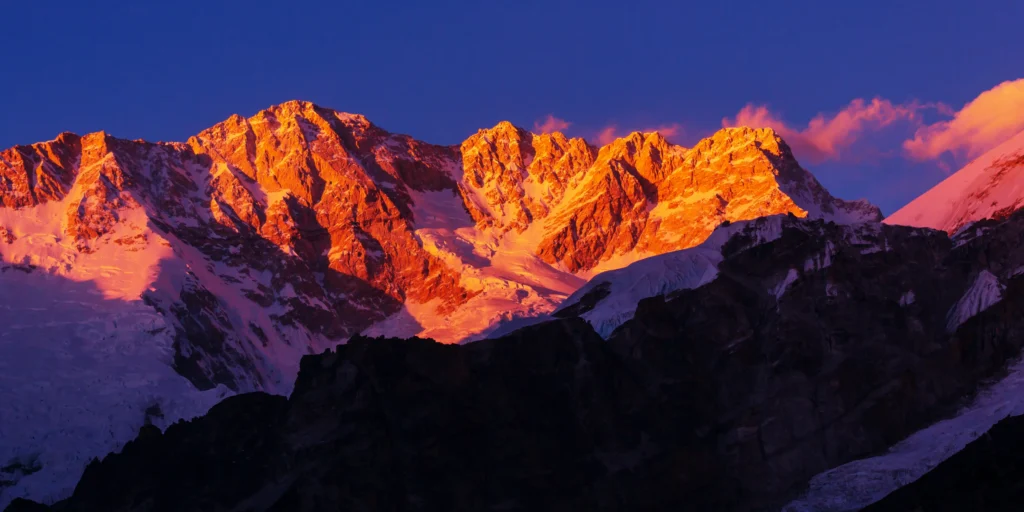
The Sacred Landscapes of Kanchenjunga
Rivers, Forests & High Mountain Guardians
A Landscape That Lives in Story, Spirit and Ecology
Kanchenjunga stretches across vast ecological zones—from subtropical valleys at 1,000 meters to glacial basins above 5,000 meters. What makes this region unique is that the landscape is not only diverse but also deeply sacred to its inhabitants.
The term sacred landscape in the eastern Himalaya refers to mountains, forests, rivers and valleys believed to be homes of protective deities, known locally by various names:
- Yuma Sammang or Mother Earth in Limbu belief.
- Nahangma, protector deities connected to peaks and ridges.
- Chorten and mani stone sites marking sacred Sherpa/Tibetan spaces.
- Forest spirits in Rai cosmology guiding ancestral pathways.
Trekking through Kanchenjunga is therefore not just movement through geography—it is entering a living cultural-spiritual landscape shaped by generations of relationship with the natural world.
The Tamor River System — The Lifeline of the South
The Kanchenjunga South Base Camp route follows the waters of the Tamor River and its tributaries—one of the most powerful Himalayan river systems. These waters originate from glacial melt high above Cheram and Oktang and carve their way down through some of Nepal’s most dramatic valleys.
Geological Significance
The Tamor is responsible for shaping:
- Deep, narrow gorges near Mamankhe and Phumphe.
- Terraced hills where Limbu communities farm millet and buckwheat.
- Mist-filled rhododendron forests as the trail climbs higher.
Spiritual Meaning
For Limbu and Rai communities, rivers are considered pathways of ancestral spirits. Rituals like Ubhauli and Udhauli mark the seasonal movement of people, birds and animals along these waterways.
Trekkers walking along the Tamor corridor experience some of the most culturally alive sections of the entire Kanchenjunga region.
Sacred Forests — The Green Temples of the Himalaya
The forests in Kanchenjunga are not merely ecological zones—they are sacred spaces. Many are protected by local belief systems long before modern conservation began.
Forest Types You Encounter
- Lower temperate oak–rhododendron forests around Yamphudin and Khebang.
- Birch and fir forests as you approach Cheram.
- Juniper scrub and high meadows near Sele Le and Sinion La.
Sacred Status
Certain forests are recognized as sacred groves where cutting trees is forbidden. These groves serve as:
- Sites of ritual ceremonies.
- Places for ancestral offerings.
- Natural sanctuaries for rare wildlife.
Local families often explain how the health of their crops, herds and communities is believed to be connected to the well-being of these forests.
Eagle Trail Escapes encourages respectful movement through these spaces—staying on trails, avoiding loud noise and supporting families who are custodians of these ecological sanctuaries.
The High Glacial Valleys — Lhonak, Pangpema & the Northern Ice World
The northern side of Kanchenjunga reveals a world shaped entirely by ice, wind and stone. Trekking to Pangpema takes you through some of Nepal’s most dramatic glacial landscapes.
Key Features
- Lhonak Valley — a vast high-altitude plain bordered by ridgelines and ice walls.
- Pangpema (North Base Camp) — a viewpoint overlooking the soaring north face of Kanchenjunga.
- Moraine fields stretching for kilometers.
- Glacier-fed rivers carving braided channels.
Spiritual Geography
Tibetan-influenced Bhote and Sherpa communities believe these upper valleys are home to protective deities—mountain spirits who watch over herders and travelers. Prayer flags at Pangpema carry good intentions into the wind, a symbolic gesture tying the human world to the mountain world.
For trekkers, standing at Pangpema feels like entering a cathedral of ice—vast, silent and overwhelming in scale.
Sacred Passes — Sinion La, Mirgin La & Sele Le
The traverse between the North and South Base Camps crosses a series of high passes that hold both ecological and spiritual meaning. These passes are gateways—thresholds between valleys, cultures and landscapes.
Sinion La (4,650m)
Known for its sweeping views toward Jannu and the far-off ridge lines leading to Tibet.
Mirgin La (4,600m)
A cultural meeting point between the trails of Phale (on the north) and Cheram (on the south).
Sele Le
A forested ridge with deep-rooted religious significance, where many local families perform rituals honoring ancestors and mountain spirits.
Crossing these passes is more than a physical journey—it is a movement through spaces that communities have honored for generations.
Wildlife Corridors — Home of the Snow Leopard & Red Panda
Sacred landscapes and wildlife conservation are deeply intertwined in Kanchenjunga. Many trails pass through recognized habitat for:
- Snow leopards
- Red pandas
- Himalayan black bears
- Blue sheep (bharal)
- Over 250 bird species
Local beliefs often act as informal conservation systems. In many villages, harming certain animal species is considered spiritually harmful—and this traditional knowledge effectively protects biodiversity.
The Kanchenjunga Conservation Area Project (KCAP) works alongside community-led groups to maintain these corridors, but traditional cultural values remain the backbone of wildlife protection.
How Eagle Trail Escapes Supports Sacred Landscape Preservation
Our role as a local-first trekking company is not just guiding—it is stewardship. We actively support:
- Homestays owned by local families so economic benefits remain in the community.
- Trail maintenance support through local youth groups.
- Promotion of traditional knowledge by working closely with Limbu, Rai and Sherpa elders.
- Leave-no-trace trekking standards across all Kanchenjunga itineraries.
By trekking with us, visitors become part of a wider effort to protect the very landscapes that make Kanchenjunga extraordinary.
To walk through Kanchenjunga is to walk through a living sanctuary—where every ridge, river and forest carries a story older than the trail itself.
Eagle Trail Escapes